

Teradata JDBC
This article describes the main steps required to create the Teradata JDBC data source collector.
Creating the Teradata JDBC data source
-
In the Navigation Panel, go to Integrations > Catalog.
-
Use the Search box OR click the Databases filter to locate the data source.
-
Hover over the Teradata JDBC tile, and click Start. The Terdata JDBC dialog is displayed, as shown below.
Note: If the data source has already been used, a dialog is displayed in which you can select from one of the listed sources. Alternatively, create a new source by clicking Add a new source.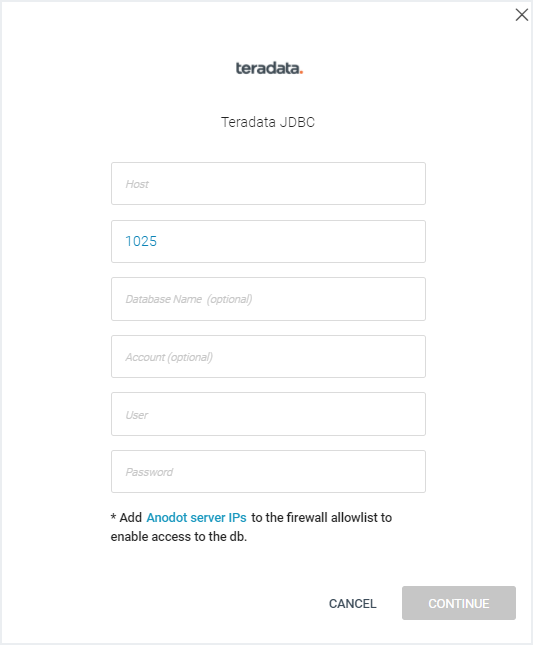
-
Enter your Host.
-
Either enter your Teradata port number or leave the default port number [1025] as-is.
-
[Optional] Enter a Database name.
-
[Optional] Enter your account.
-
[Optional] Enter a user name.
-
[Optional] Enter a user password.
-
Add an Anodot server IP to your firewall's allowlist. See Allowlist Anodot Servers .
-
Click CONTINUE to display the Stream Query.
Creating the Teradata JDBC data stream
If you have just created a Teradata JDBC data source, skip to step 3.
- In the Sources page (accessed by clicking Integrations > Sources in the Navigation Panel), filter the list of streams to find the source for which you want to create a stream query.
Note: The streams associated with that source are displayed. If the streams panel is empty, no stream queries exist for that source. - Hover over the Teradata JDBC data source, and click + New Stream. The Stream Query page is displayed.
- Define your stream query settings.
- Review the Stream Query page to confirm your chosen stream data.
- Click NEXT. The Stream Table is displayed; see Stream Tables for more information.
Updated over 1 year ago